
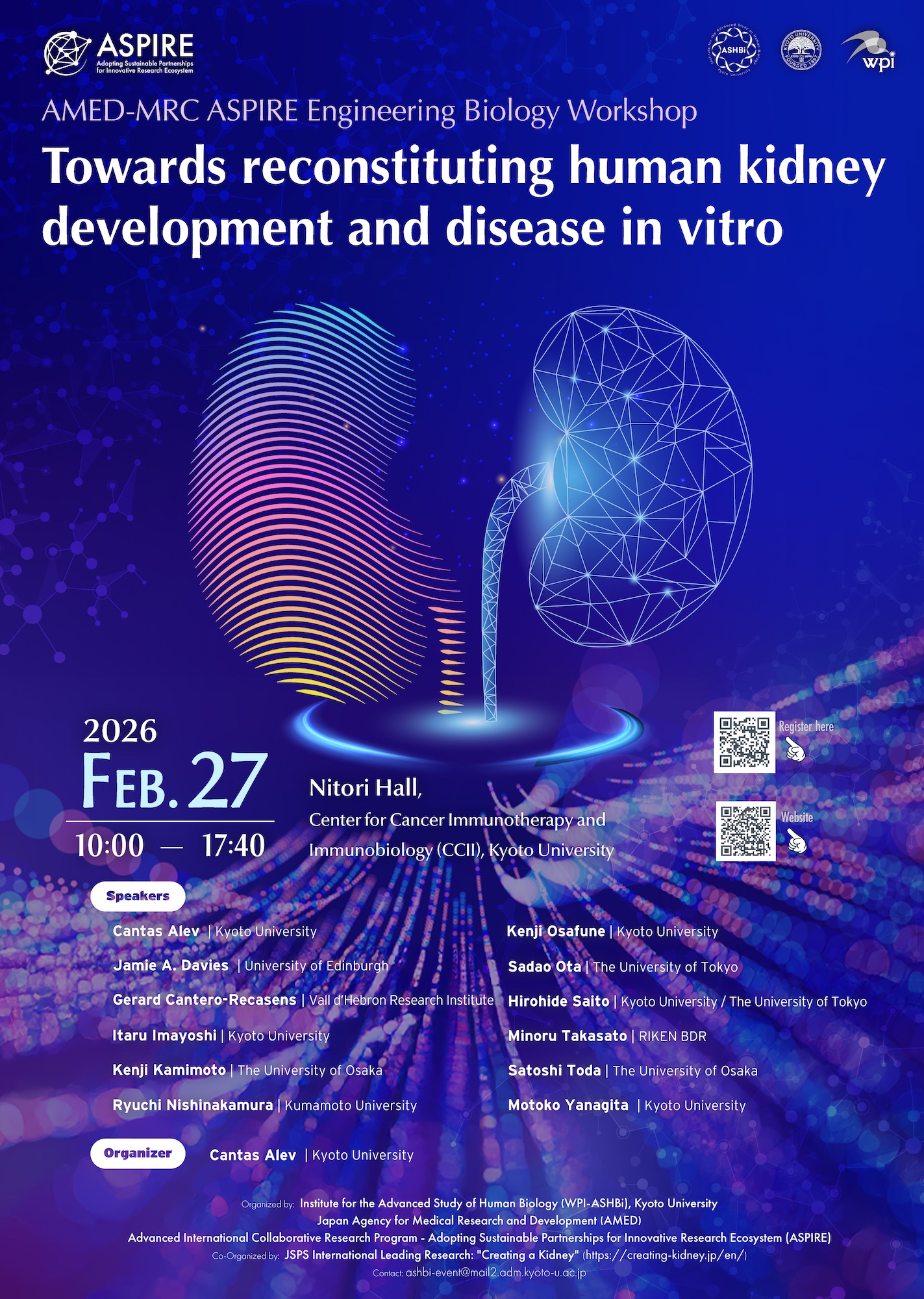
We are delighted to host the AMED-MRC ASPIRE Engineering Biology Workshop – Towards reconstituting human kidney development and disease in vitro, taking place on February 27, 2026.
This joint workshop brings together leading researchers and young scientists from Japan and the UK to connect two rapidly advancing fields: kidney development and in vitro kidney and embryo models, with latests advances in synthetic and systems biology. By combining expertise in renal organogenesis and stem cell–based model systems with quantitative, programmable, and engineering-driven approaches, the workshop aims to explore new ways to analyse, control, and reconstruct kidney development and disease in vitro. The meeting is designed to foster cross-disciplinary dialogue and seed new collaborations that will drive conceptual and technological innovation at the interface of developmental biology and synthetic biology.
We warmly invite anyone interested to join us.
開催日
-
2026/2/27
10:00–17:40
開催場所(方法)
Nitori Hall, Center for Cancer Immunotherapy and Immunobiology (CCII), Kyoto University
/ 京都大学 がん免疫総合研究センター (CCII) 多目的ホール(NITORI Hall)
詳細
参加申込/Registration| https://forms.gle/8PSJ8ogMPmjBKSAT6
Website| https://ashbi.kyoto-u.ac.jp/event/event-workshop/21492/
日時/Date & Time | Friday, 27 February 2026, 10:00 – 17:40
会場/Venue | Nitori Hall, Center for Cancer Immunotherapy and Immunobiology (CCII), Kyoto University Registration|
言語/Language| English
対象/Eligibility| All Academic Researchers and students
Program|
Session 1 (chair: Cantas Alev) / 10:00–11:50
• Jamie Davies | University of Edinburgh
Seeking new targets in Autosomal Dominant Polycystic Kidney Disease (ADPKD)
• Natalia Penar| University of Edinburgh
The mechanisms of epithelial symmetry-breaking in mammalian morphogenesis
• Motoko Yanagita | Kyoto University
A Novel Perspective on Kidney Repair: Collaborative Cellular Responses and Regulatory Mechanisms
• Gerard Cantero-Recasens | University of Edinburgh / VHIR
Modeling Rare Renal Pathologies: From ClC-5 Dysfunction to Novel Therapeutics in Dent’s Disease
• Shunsuke Tanigawa | Kumamoto University
Generation of higher-order kidney structures solely from pluripotent stem cells
• Ryuichi Nishinakamura | Kumamoto University
Generating and Maturing Kidney Organoids
Session 2 (chair: Ryuichi Nishinakamura) / 13:20–15:10
• Itaru Imayoshi | Kyoto University
Uncovering Novel Transcriptional Regulatory Mechanisms of Neural Stem Cells Using Optogenetic Approaches
• Tomonori Fukuda| University of Edinburgh
Engineered compact photo-activatable transcription factors for controlling gene expression in mammalian cells
• Kenji Kamimoto | The University of Osaka
Data-driven in silico reconstruction of gene expression program towards understanding and controlling of cell dynamics
• Anna Sophie Brumm | University of Edinburgh
Novel approaches to uncover cell interactions which balance differentiation of human neuromesodermal progenitors
• Satoshi Toda | The University of Osaka
Programming multicellular patterns with synthetic cell-cell communication
• Hirohide Saito | Kyoto University / The University of Tokyo
Synthetic RNA Technologies to control gene expression and cell fate
Session 3 (chair: Hirohide Saito) / 15:40–17:30
• Minoru Takasato | RIKEN BDR
Generation of urinary tract organoids from human pluripotent stem cells.
• Nicholas Younger | University of Edinburgh / Kyoto University
Towards an Integrated Model of Kidney Development
• Kenji Osafune | Kyoto University
iPSC organoid-based disease modeling and drug discovery for kidney diseases
• Mert Akgunduz | Kyoto University
An organizer-based in vitro model of human gastrulation and organogenesis (OMO)
• Sadao Ota | The University of Tokyo
Beyond Organoid Heterogeneity: In-Capsule Platforms for Quality-Controlled, High-Throughput Screening
• Cantas Alev | Kyoto University
Towards reconstituting human and primate early embryonic development in vitro
Organizer| Cantas Alev (ASHBi, Kyoto University)
申し込み
要申し込み
https://forms.gle/8PSJ8ogMPmjBKSAT6
参加費
Free / 無料
お問い合わせ
Contact | ashbi-event[*]mail2.adm.kyoto-u.ac.jp
Please change [*] to @.